Earning the doctorate degree PhD, MD/PhD or DMD/PhD
With the introduction of the PhD, MD/PhD and DMD/PhD programmes, University Medicine Greifswald offers high-achieving graduates of medicine, dentistry, and natural and life sciences the opportunity to conduct a structured doctorate with a focus on research, and thus excellent prospects for their further professional career and the continuation of an academic career, especially in an international context.
The most important information at a glance:
- The basis of the doctorate is the publication of your own research results in at least 3 original scientific publications (cumulative thesis)
- The period between requesting admission to the doctoral procedure and the submission of the thesis is usually 3 years
- Completion of an accompanying curriculum amounting to 24 ECTS (courses, participation in congresses, continuing education)
- Supervision of the research work by a thesis committee and conclusion of a supervision agreement
Doctoral Board PhD, MD/PhD, DMD/PhD
Chair: Prof. Elke Krüger
The doctoral board decides, among other things, on admission to the PhD and appoints the members of the Thesis Advisory Committee.
Upcoming dates:
- 20 October 2026
- 10 November 2026
- 15 December 2026
- 19 January 2027
- 16 February 2027
- 16 March 2027
The doctoral board usually meets on the 3rd Tuesday of the month.
Documents and applications are to be handed in 14 days in advance
Before admission
The following requirements apply for admission to the doctoral programmes:
Doctor of Philosophy (PhD)
- Master's degree or equivalent university degree in a natural or life science subject other than human medicine or dentistry (min. 300 credit points)
- Overall grade of "good" or better (better than 2.5)
Medical Doctor/Doctor of Philosophy (MD/PhD)
- Passed the medical examination (state examination)
- Overall grade of "good" or better
Doctor of Medical Dentistry/Doctor of Philosophy (DMD/PhD)
- Passed the dental examination (state examination)
- Overall grade of "good" or better
The first step in preparing your doctorate is to find a supervisor in the desired subject area. The supervisor must be a habilitated member of University Medicine Greifswald, i.e. professor or associate professor (Prof., apl. Prof., Privatdozent (PD)). Co-opted professors from other faculties of Greifswald University can also supervise doctorates at UMG.
Your doctoral subject corresponds to the designation of the chair of your supervisor, or the chair your supervisor belongs to.
Your doctorate will later be supervised by an individual thesis committee, which is appointed by the doctoral board as part of the admission process. In addition to your supervisor, this committee includes two other members; also habilitated; one UMG-internal and one UMG-external person. This way, expertise from different areas that are relevant to your research project is combined. When you complete your doctorate, the thesis committee is responsible for conducting and grading the doctoral defense.
Degrees obtained abroad must be checked for equivalence to the above-mentioned admission requirements before you can be admitted to the doctoral programme. Please have your certificates and transcripts of records checked by the ZAB (Central Office for Foreign Education).
You can apply online for the evaluation of your degrees:
Please submit the ZAB's evaluation along with your degree certificates, transcripts of records and further application documents (see Application for admission) to the Dean's office.
To apply for admission to the doctoral programme, you will prepare a detailed work plan (exposé) of your research project together with your supervisor, including the planned timeline. The exposé should consist of 3-4 pages and follow the prescribed structure (see below, Admission to the doctoral procedure).
In addition, you and your supervisor will compile a list of the courses that you will attend during the qualification phase (for specifications, see Accompanying curriculum below). Apart from the compulsory part, you will select further courses that complement or deepen skills and knowledge relevant to your research project. Courses that you attended as part of your academic studies (e.g. Masters') cannot be credited or taken again. German courses cannot be credited either.
The curriculum is generally begun after admission to the doctoral programme. The crediting of courses that you have previously taken is possible in exceptional cases; max. 12 months retrospectively. The decision lies with the doctoral board. For examination, please fill out the form Request for recognition of lectures already completed and submit it with your application for admission.
To support the administration of doctoral procedures, an internal database is used at University Medicine Greifswald, the Research Information System (RIS, German: Forschungsinformationssystem / FIS).
After entering and saving your data (address, degree, doctoral topic, etc.), you can generate the application form for admission to the doctoral procedure as well as the confirmation of acceptance as a doctoral student (required for enrolment at the University) by klicking the respective buttons at the top of the data sheet.
If you are not employed or enrolled at the University or University Medicine, please send a request for login-details by e-mail to mathilda.guerinmed.uni-greifswaldde. You will receive a registration link. For further information, see Electronically supported doctoral procedure.
Admission to the doctoral procedure
Admission to the doctoral procedure must be requested before starting the research and curriculum. Please send the following documents by post (Dekanat, Fleischmannstr. 8, 17489 Greifswald) and by e-mail in one pdf-file to mathilda.guerinmed.uni-greifswaldde:
- Request for Admission to the Doctoral Procedure PhD, MD/PhD or DMD/PhD
(application form with handwritten signature; to be generated in the RIS) - Curriculum vitae with information about your academic career
(with handwritten signature) - Certified copies of all university degree certificates (degrees obtained abroad must be checked for equivalence in advance, see above); for degrees that were issued in a language other than English or German a certified translation is to be obtained, i.e. by a certified translator in Germany after presenting the original document; single copies of transcripts of records (with German or English translation if necessary)
- Agreement to supervise the doctoral procedure, including suggestions for thesis committee members (signed by the supervisor, see Templates for admission to the doctoral procedure)
- Scientific work plan of 3-4 pages (see Templates for admission to the doctoral procedure)
Preliminary plan of accompanying curriculum, according to the requirements for compulsory and elective parts
(co-ordinated with the supervisor, see Templates for admission to the doctoral procedure)If applicable, request for recognition of a semester off completed for research purposes as part of the degree course (informal; proof of completion of the semester off must be provided)
- If applicable, Request for recognition of lectures already completed
- Confirmation of Acceptance as Doctoral Candidate for enrolement as a doctoral student (after admission to be handed in at the Students’ Registration Office, Rubenowstraße 2, see Doctoral website University of Greifswald)
You will be informed in writing about the admission to the doctoral program or the rejection of your application.
Please sign the supervision agreement (Betreuungsvereinbarung) with the members of your thesis committee within 6 weeks of admission and submit a copy (scan by e-mail) to the Dean's Office. The supervision agreement should ensure that you receive the best possible supervision during your qualification phase. Here, for example, you specify the frequency of meetings with the thesis committee and undertake to exchange information and comply with the principles of good scientific practice.
You should organise the first meeting with your thesis committee soon after admission in order to present your research exposé and the planned curriculum to all members.
After your admission to the doctorate, you enrol as a doctoral student at the University of Greifswald. Please submit the following documents to the Students' Registration Office (Studierendensekretariat) in person or by post; enrolment for doctoral studies is possible outside the usual semester deadlines.
Documents for enrolment:
- Application for enrolment (application form; TEMPLATE with instructions for easy completion)
- Complete paragraphs 1, 2, 4, 5 and 7 in full
- Any further details you need to fill in are highlighted in yellow in the template
- Attach a passport photo on page 1
- Bestätigung der Annahme als Doktorand*in (Confirmation of Acceptance as Doctoral Student) with supervisor's and Dean's signature
- CV
- Simple copy of your higher education qualification (state examination, diploma, Bachelor’s/Master’s degree, etc.)
=> Please do not submit certified copies or originals! - Simple copy of your university entrance qualification (e.g. A-level certificate)
- If you have previously been enrolled at a higher education institution in Germany, a certificate of withdrawal (Exmatrikulationsbescheinigung)
- ID card or passport (a COPY if submitting documents by post!)
- Return envelope (A5 or A4) with stamps and your address when submitting documents by post
Contact:
University of Greifswald
Students' Registration Office
Rubenowstr. 2
17489 Greifswald
Tel.: +49 3834 420 1296
studsekuni-greifswaldde
Qualification phase (ca. 3 years)
The qualification phase usually lasts three years and begins with admission to the doctoral procedure. During the qualification phase, you will conduct the scientific research on which your dissertation thesis is based. You will first publish your research results in peer-reviewed journals before writing your dissertation on the basis of at least three original publications.
In addition, you will acquire a sound understanding of scientific problems, in-depth specialist knowledge and the ability to work in an interdisciplinary manner. On the one hand, you will do this in exchange with your colleagues, research group leaders, other doctoral researchers and your thesis committee. On the other hand, you will acquire specific knowledge and skills that will advance you and your research project within the framework of the accompanying curriculum.
Regulations on qualitative and quantitative requirements for publications
(Appendix 3 to the PhD, MD/PhD, DMD/PhD Doctoral Regulations)
- In the three required original publications of the cumulative thesis, the doctoral candidate must have acted as first author at least once. Among the three original publications, there may be in exceptional cases one paper that has been submitted for publication at the opening of the doctoral procedure but has not yet been finally accepted for publication.
- The journals to which the papers have been published or accepted for publication or submitted should be able to be assigned subject-specifically according to the criteria of a recognised bibliographic database such as Web of Science.
- The cover text ("Manteltext") within the thesis should be at least 6,000 and at most 12,000 words long (approx. 20-40 pages) excluding the bibliography, and should be structured as follows: short Summary of one page both in German and English, Introduction, Methods and Materials, Results, Discussion. The cover text serves to link the publications in terms of content (embedding them in an overarching context) and to discuss issues that go beyond the topics dealt with in the publications. For example, methodological principles, calculations or evaluations can be described in more detail, and further results or problems that have arisen after the publications were published can be addressed.
- The doctoral candidate's share in the publications must be documented (when submitting the thesis) by a written declaration from the doctoral candidate and the supervisor to the doctoral board. In the case of publications in which the doctoral candidate is the first author, he/she must have played a predominant role in the planning of the scientific work, the data collection and/or analysis, the evaluation and the interpretation of the results. In the case of publications for which the doctoral candidate is co-author, he/she must have played a significant role in the planning of the scientific work, the data collection, the evaluation and the interpretation.
- If two persons share a first authorship, this can be counted as a full first authorship upon justified application by the thesis committee. The application is decided by the doctoral board and should be submitted before the thesis is submitted. In the case of three or more first authorships for one article, such a request is excluded.
The thesis committee monitors the progress of the doctorate and is later responsible for organising and grading the doctoral colloquium (see also information sheet for members of a thesis committee).
You arrange regular meetings (possibly via video conference) with your thesis committee to report on the status of your doctorate (research, curriculum, publications), to clarify questions and any problems, and to receive important feedback. You have jointly agreed on the frequency of your meetings in the supervision agreement (usually 1-3 meetings per year).
To prepare and record the meetings, please use the template for the
Please note that the progress report is to be completed by you in advance and sent to the members of the thesis committee by e-mail two weeks before the meeting. The minutes of the meeting will be taken by your supervisor.
At least once a year, you send the completed and signed progress report to the Dean's Office (mathilda.guerinmed.uni-greifswaldde).
Accompanying curriculum
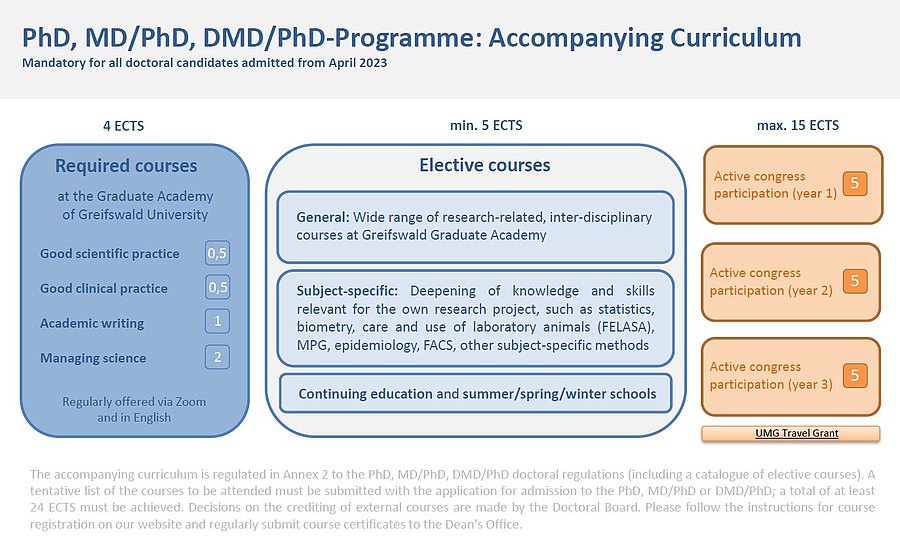
The accompanying curriculum is divided into three parts: complusory courses (4 ECTS), elective courses with interdisciplinary and subject-specific components (min. 5 ECTS), and the possibility of crediting active congress participation (max. 15 ECTS). A total of at least 24 ECTS must be achieved (§ 5 Para. 4 PromO).
Note: The structured curriculum described here is mandatory for all admissions from April 2023. Doctoral candidates who were admitted before this date will complete an individual curriculum (as confirmed by the doctoral board with admission to the program).
In order to ensure a uniform allocation of ECTS points in the curriculum for all doctoral candidates regardless of the course provider (e.g. Graduate Academy, University or University Medicine Greifswald), the following system applies in the PhD, MD/PhD, MD/PhD programme:
Regular courses
such as lectures and seminars, usually at least 10 courses per semester, 1 SWS = 45 mins to 60 mins
1 SWS = 1 ECTS
2 SWS = 2 ECTS
3 SWS = 3 ECTS
4 SWS = 4 ECTS
Block courses
such as workshops and block seminars, 0.5 days = at least 4 hours
0.5 to 1 days = 0.5 ECTS
1.5 to 2 days = 1 ECTS
2.5 to 3 days = 1.5 ECTS
3.5 to 4 days = 2 ECTS
4.5 to 5 days = 3 ECTS
Participation in at least 80 % of the dates must be proven for a course to be recognised.
The compulsory curriculum is undertaken at the University of Greifswald’s Graduate Academy. Compulsory modules are regularly offered in English and via Zoom.
The Graduate Academy’s course programme is usually announced in May for the second half of the year and in December for the first half of the coming year. Please register for your chosen courses yourself.
Good Scientific Practice / 8 hours / 0.5 ECTS
usually offered as an ‘on-demand’ course, i.e. enrolment is possible at any time
Good Clinical Practice / 8 hours / 0.5 ECTS
usually once a year, on Thursday the week before Ascension Day (Himmelfahrt); next date: 29 April 2027
Academic Writing / 1-1.5 Days / 1 ECTS
usually in the summer term, once a year
Lecture series “Managing Research” / 8 out of 10 sessions (60–90 minutes each) / 2 ECTS
during the winter term, Tuesdays or Thursdays, 12-2 pm
Course registration:
General research-related courses
All research-related courses offered by the Graduate Academy (GA) of the University of Greifswald as part of the qualification programme for doctoral candidates may be counted towards the elective component of the accompanying curriculum.
Examples:
Research data management
Gender equality, gender awareness
Getting published
Improved reading
Conflict management
Patent management
Presentation techniques and training
Project and time management
Statistics
Scientific communication
Course dates and registration:
Subject-specific qualification
In addition to general research-related qualification, PhD students may choose courses that are particularly relevant to their research project, such as Summer Schools on relevant methods or lectures at Greifswald University or University Medicine Greifswald.
Participation in conferences where the PhD student delivers their own oral presentation or poster presentation will be recognised as part of the accompanying curriculum.
A maximum of one conference participation may be recognised per calendar year, up to a total of three conferences (5 ECTS each).
Active conference participation is defined as the presentation of the PhD student’s own research work as a poster presentation or oral presentation at a national or international scientific conference with a competitive abstract selection process. Institute seminars, project meetings (including those held across regions), as well as conferences or symposia with a narrowly defined topic and a limited number of participants (e.g. within the framework of an RTG, SFB or CRC/Transregio), and events exclusively for early-career researchers are not recognised as active conference participation within the framework of the accompanying curriculum for the PhD.
To receive credits, please submit the following documents, combined into a single PDF file:
- Confirmation of active participation from the organiser (e.g. an email saved as a PDF)
- Poster (in PDF format) or abstract of the presentation
- if possible: confirmation of attendance from the organiser
To encourage active participation in conferences, University Medicine Greifswald offers a travel grant for early-career researchers (up to €500 for conferences in Germany and up to €1,000 for conferences abroad).
Thesis Submission
The dissertation should summarise at least three original publications with related content that have been published in renowned journals (cumulative dissertation).
The reference to University Medicine Greifswald must be recognisable in all publications and the thesis must relate to a subject area according to Appendix 1 to the PhD doctoral regulations. For further information on requirements for the publications and first- or co-authorship, see Appendix 3.
A jacket text of 20-40 pages links the publications in terms of content and provides additional insights or outlooks into the topic. When preparing your dissertation, please refer to
You can request that the doctoral procedure be initiated after you have completed the accompanying curriculum (approximately 3 years after admission). Please send the following documents to the Dean’s Office:
- Request for Initiating the Doctoral Procedure
(application form with handwritten signature; should be completed in RIS) - 3 printed and bound copies of the thesis including the original publications
- Proof of lectures and congresses/training attended
(see accompanying curriculum/qualification phase) - Official certificate of good conduct (document type 0 = official)
not older than 3 months when submitting the doctoral thesis
to be addressed directly to: Dekanat, Fleischmannstraße 8, 17475 Greifswald - If applicable, declaration of shares in publications and shared lead authorship
(with handwritten signature)
Applicants will be informed in writing that the doctoral procedure has been initiated.
After the doctoral procedure has been initiated, an internal first assessment and an external second assessment are requested. If the thesis is evaluated with at least "rite" by both assessors, the oral examination (doctoral colloquium) takes place.
The doctoral colloquium is held before the thesis committee and is comprised of a presentation (max. 30 minutes) and a scientific discussion (30-90 minutes). The language of the presentation is German or English.
The date is set by the thesis committee and is announced to the doctoral candidates at least 14 days in advance. The colloquium is open to the public and will be announced to the members of the faculty.
Completion of the doctoral procedure
After passing the doctoral colloquium, the thesis must be published in an unchanged and complete form according to § 12 PromO PhD (4 durable bound copies and a pdf file). The copies are to be submitted to the University Library, Felix-Hausdorff-Str. 10 (Ms. Franzus, Tel. 03834 420 1519 (printed copies) and Ms. Waha, Tel. 03834 420 1553 (electornic version)) . For more information, please visit the
Central University Library Website.
The Dean's Office will be notified of the thesis submission by the University Library.
After submitting the required copies to the University Library, a confirmation of successful completion of the doctoral procedure is issued. This entitles the doctoral candidate to use the doctoral title - for a limited period of time until the original certificate is presented.
The award of the doctoral certificates takes place during a festive ceremony in May/June each year at St. Nikolai church (Domstr. 54, Greifswald, "Verleihung der akademischen Grade"). Doctoral candidates will receive an invitation and are kindly asked to confirm by e-mail whether or not they will attend the ceremony. If participation is not possible or not desired, the certificates will be sent by post.
Networking in the PhD, MD/PhD, DMD/PhD programme
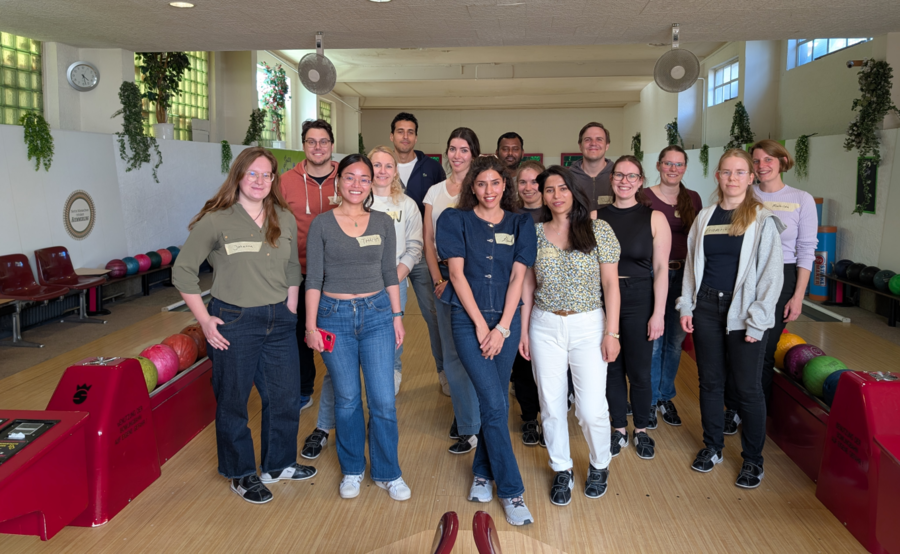
The structured doctorate offers the opportunity for academic and personal exchange between different disciplines in an international group of doctoral students.
Getting together. Two to three times a year, we meet in a relaxed atmosphere to exchange ideas and get to know each other. Details via PhD-Newsletter.
Upcoming meetings:
Thu, 23 July 2026
Fri, 27 November 2026
Thu, 29 April 2027
PhD Lunch-Stammtisch. Every fourth Thursday of the month from 11:30 am to 1:00 pm in the Mensa at Beitz Platz.
PhD Spokespersons. Contact persons for the informal exchange among doctoral candidates:
Ms. Johanna Schmidt, Clinic for Neurology, e-mail
Ms. Marleen Oswald, Institute of Physiology, e-mail
Mr. M. Kamal Nasr, Clinic for Psychiatry and Psychotherapy, e-mail
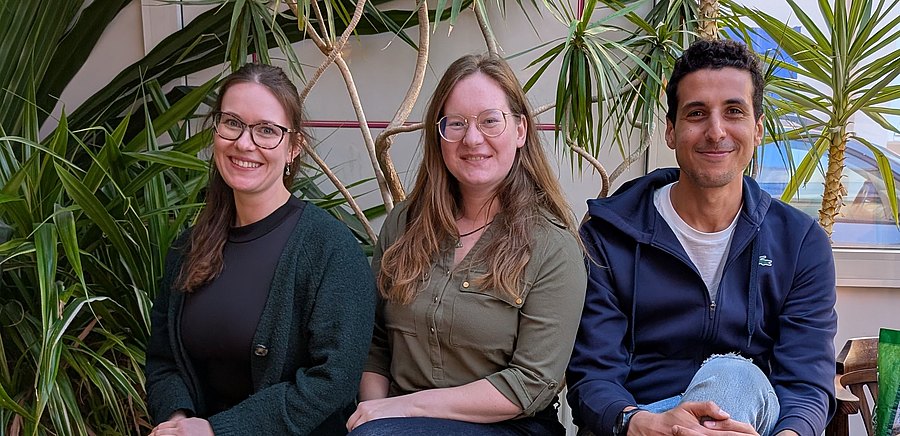
PhD Spokespersons: Marleen Oswald, Johanna Schmidt, M. Kamal Nasr (left ro right)
Tasks of the PhD Spokespersons include the organisation of regular meetings and of other formats to promote internal networking among all doctoral candidates, advancing the PhD programme through feedback and regular exchange with the PhD administration, and acting as trusted contact persons to all doctoral candidates. To get in touch, please see contact details above.
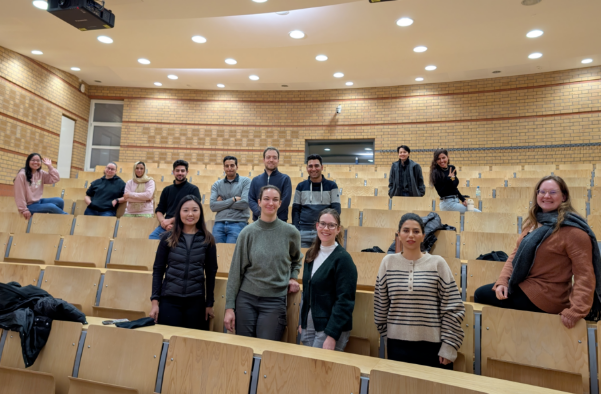
PhD Get-together 2025, Hörsaal-Kino
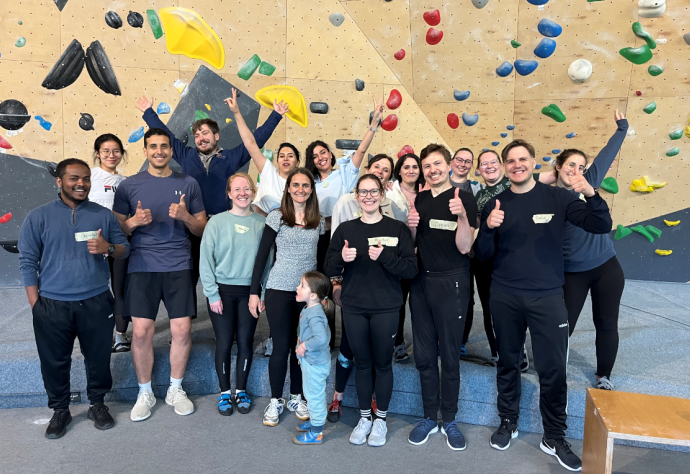
PhD Get-together 2025, Grips Boulderhalle
Contact
Mathilda Guerin
Universitätsmedizin Greifswald
Dekanat/Wissenschaftlicher Vorstand
Fleischmannstr. 8 (2nd floor, room A1.2.6)
17475 Greifswald
Tel: +49 3834 86-5012
Fax: +49 3834 86-5002
E-Mail: mathilda.guerinmed.uni-greifswaldde